Tweet
A great friend of mine has just had his shoulder replaced because of advanced arthritis to the affected joint. He's a very tough guy, but even he tells me that he's had a very painful post op period. But then that's one of the downsides to shoulder surgery - pain with a capital P - and why is shoulder surgery so painful? One of the reasons maybe that we don't realize how much we use the shoulder to brace the arm when we use our hands, and just turning over in bed at night can be like having a branding iron thrust into the affected shoulder. The good news is that it eventually goes away and you will have a much better functioning shoulder: the not so good news is that it can take up to 6 months to get there!
So why am I sounding negative all of a sudden? Well I'm not really because the focus of treatment should always begin with prevention, and we can do a great deal to reduce the chances of suffering from advanced arthritis of the shoulder.
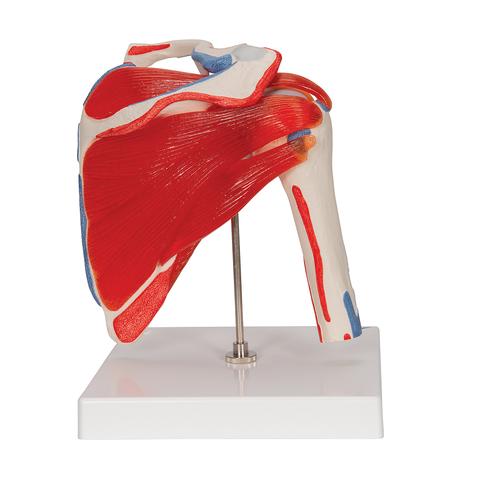
Firstly posture: most of the work we do each day is "in front of us" which means that the "front muscles" tend to be pretty toned up - think those buffed pectoral muscles. But the ones behind us, between the shoulder blades, tend to get stretched and become weaker, with the result that a great number of people have "Hunched" shoulders, and hunched shoulders mean that the bio-mechanics of the shoulder-moving-muscles become inefficient.
A group of these muscles are known as the Rotator Cuff muscles, and they are four in number, and each of them is attached to the shoulder blade (scapular) at one end. At their other end, their tendons blend with the tough lining that attaches the upper arm (humerus) to the scapular and which is known as the Capsule of the Shoulder joint. When we are young and active we can often damaged these tendons/capsule at sport - swimming, baseball, contact sports etc - and once we go past 40 we can also get a build up of calcium in these damaged tendons/capsule, all of which can lead to inflammation, tendon tears and arthritis.
To reduce the chances of this happening:
1. Maintain good posture - imagine that someone has placed a finger on the crown of your head and you have to gently push up against it. This straightens the spine, pushes out the chest and the shoulders naturally fall back allowing the muscles to act more efficiently.
2. Keep good tone in all your shoulder girdle muscles: there are online physiotherapy sites for these exercises, but my recommendation is always to see your own physical therapist for a personal assessment and individual programs - believe me it's worth it!
3. If you suffer an injury or pain in the shoulder get it assessed early. You can start ice/heat and simple pain killers whilst you wait for your appointment, and if you don't have a medical condition which stops you using anti-inflammatory medications, start them as well (if you're not sure, don't take them).
4. Don't move the shoulder in ways that makes it painful: but if you can move it a little bit in a non painful way, then that's OK.
Shoulder surgery is painful, and a full joint replacement or repair does take time: but with proper rehabilitation during recovery, you will be extremely grateful that you had it done. But if you can avoid it by taking good care of your shoulder earlier on in life, you've just freed up 6 months of great living!
image
Ampersands & angle brackets need to be encoded.Monday, February 13, 2012
Friday, February 10, 2012
Nanotubes and treating breast cancer.
Tweet
Many years ago I pondered how one day I would cure cancer! The idea I came up with, was I thought, pretty smart. I'd learned somewhere that everything has a natural resonance, and my idea was to introduce a metal into a cancer cell (I thought of using some altered variety of the common cold virus) and then to apply the correct sound from outside the body that would resonate that particular metal. The result would be, to my mind at least, that the individual cells would turn to mush and hey presto, cancer cured.
Like all good, simple ideas, it didn't progress any further, probably because
1. I didn't have the odd $10Million to set up a team and equipment to work on my theory, and
2. I was a humble GP with five very hungry children to feed and
3. It wouldn't have worked anyway
But I was reminded of my idea when I read about how researchers are using muti-walled nanotubes for the treatment of breast cancer. Apparently there are breast cancer stem cells that are particularly resistant to treatment and are thought to be responsible for the spread/metastasis of breast cancer and unfortunatley the usual readiation therapy doesn't work on them.
But the nanotubes, although made of carbon, when exposed to certain laser radiation, heat up and kill the cells they are in. At this stage it appears that the nanotubes are injected directly into cancer tumours, the hope is that they can be "delivered" to individual metastases and then activated. That dream is still a long way off, but then 20 years ago I thought 10 years seemed a long time too.
reference
image
Ampersands & angle brackets need to be encoded.Follow @DrDJsScript
Like all good, simple ideas, it didn't progress any further, probably because
1. I didn't have the odd $10Million to set up a team and equipment to work on my theory, and
2. I was a humble GP with five very hungry children to feed and
3. It wouldn't have worked anyway
But I was reminded of my idea when I read about how researchers are using muti-walled nanotubes for the treatment of breast cancer. Apparently there are breast cancer stem cells that are particularly resistant to treatment and are thought to be responsible for the spread/metastasis of breast cancer and unfortunatley the usual readiation therapy doesn't work on them.
But the nanotubes, although made of carbon, when exposed to certain laser radiation, heat up and kill the cells they are in. At this stage it appears that the nanotubes are injected directly into cancer tumours, the hope is that they can be "delivered" to individual metastases and then activated. That dream is still a long way off, but then 20 years ago I thought 10 years seemed a long time too.
reference
image
Thursday, February 9, 2012
Removing Ear wax: some simple Rules.
Tweet
It's stimulating to scan the journals and see what those amazing researchers are up to in their Labs - stem cell therapy, gene therapy, nano particles to cover artificial joints and so on. But every so often it's good to remember that in medicine, common things happen commonly! And one of the bane of many peoples lives is ..... ear wax!
Ear wax removal is the stuff of legend amongst Ear Specialists, or more truthfully, the stories they tell of how their patients have attempted to remove wax from their own ears with paper clips, cotton buds, tweezers and just about anything that the imagination can conjure up has been tried at some time or other to get that tricky wax out of the ear canal. "Ear candling" was in vogue for some time as well but is ineffective, and the hot candle wax and naked flame do increase the dangers of unnecessary burns.
There are a number of obstacles to removing the wax oneself, and probably the most obvious is that you cannot see inside your own ear canal: in fact, there may not be any wax in there in the first place! So Rule Number One, if you think you might have wax in your ear(s), please go an see your family Doctor, because she/he has the right tools and the right instruments to be able to properly deal with the problem.
Secondly, the interesting thing about wax production is that it's only the outer one third of the ear canal that actually produces any wax: so if you insert a blunt object such as a cotton bud, into the outer canal, all you are going to do is push what's outside further inside and leave more room for more wax to be produced! Rule Number Two: never put anything smaller than your elbow in your ear canal!
Wax and hairs in the outer third of the ear canal keep dust and wandering insects out of the ear canal: and they do a very good job of that. Deep inside the ear canal is the ear drum, and the ear drum does not appreciate having pointed object being probed into it in an attempt to remove any stubborn wax. Rule Number Three: never push anything sharp into your ear canal - this is a recipe for disaster!
IF you have a history of repeat build up of wax in your ear then there are a couple of simple things you can do prior to a visit to your Doc for her/him to remove it. Baby oil - warmed to body temperature - put in the ear over night for a few nights will help soften the wax, as will body temperature water for a few hours prior to the actual Doctors appointment. This will mean that if there is wax there, then it can be removed more easily, and even if there is no wax there then no harm will have been done. But, Rule Number Four: never put anything in your ear if anything is coming out in the form of a discharge, and never put anything in your ear canal if you know you have a perforation in your ear drum or if you suspect it might be infected.
The look of happiness on patients faces after having plugs of wax removed is very rewarding to see: but to see someone with a damaged ear canal, or with a perforated drum as a result of a failed home remedy, is to see someone in severe pain which can take days to settle and may even lead to permanent hearing loss.
Stick to the Rules!
image
Ampersands & angle brackets need to be encoded.Follow @DrDJsScript
Ear wax removal is the stuff of legend amongst Ear Specialists, or more truthfully, the stories they tell of how their patients have attempted to remove wax from their own ears with paper clips, cotton buds, tweezers and just about anything that the imagination can conjure up has been tried at some time or other to get that tricky wax out of the ear canal. "Ear candling" was in vogue for some time as well but is ineffective, and the hot candle wax and naked flame do increase the dangers of unnecessary burns.
There are a number of obstacles to removing the wax oneself, and probably the most obvious is that you cannot see inside your own ear canal: in fact, there may not be any wax in there in the first place! So Rule Number One, if you think you might have wax in your ear(s), please go an see your family Doctor, because she/he has the right tools and the right instruments to be able to properly deal with the problem.
Secondly, the interesting thing about wax production is that it's only the outer one third of the ear canal that actually produces any wax: so if you insert a blunt object such as a cotton bud, into the outer canal, all you are going to do is push what's outside further inside and leave more room for more wax to be produced! Rule Number Two: never put anything smaller than your elbow in your ear canal!
Wax and hairs in the outer third of the ear canal keep dust and wandering insects out of the ear canal: and they do a very good job of that. Deep inside the ear canal is the ear drum, and the ear drum does not appreciate having pointed object being probed into it in an attempt to remove any stubborn wax. Rule Number Three: never push anything sharp into your ear canal - this is a recipe for disaster!
IF you have a history of repeat build up of wax in your ear then there are a couple of simple things you can do prior to a visit to your Doc for her/him to remove it. Baby oil - warmed to body temperature - put in the ear over night for a few nights will help soften the wax, as will body temperature water for a few hours prior to the actual Doctors appointment. This will mean that if there is wax there, then it can be removed more easily, and even if there is no wax there then no harm will have been done. But, Rule Number Four: never put anything in your ear if anything is coming out in the form of a discharge, and never put anything in your ear canal if you know you have a perforation in your ear drum or if you suspect it might be infected.
The look of happiness on patients faces after having plugs of wax removed is very rewarding to see: but to see someone with a damaged ear canal, or with a perforated drum as a result of a failed home remedy, is to see someone in severe pain which can take days to settle and may even lead to permanent hearing loss.
Stick to the Rules!
image
Monday, February 6, 2012
St Valentines Day "Wish list" for happy Hearts.
Tweet
Can it be that Valentines Day is here once more? And once again no doubt, flower shops will do a roaring trade in last minute flower sales to those men who want to
1 make a good impression
2 make up for a bad impression
3 lack any other inspiration for a meaningful gift.
Card sellers and purveyors of Champagne will also be keen to promote the magical benefits of their products, so is there any hope that we health professionals could find a romantic place in the hearts of our beloved ones? Here's my list of suggestions on how to unlock the key to your lovers heart, in a heart friendly sort of way.
Chocolate: just the very word evokes sheepskin rugs in front of open fires and smokey jazz played softly in the background. But it has to be 70% cocoa dark chocolate if you really want to make that heart feel good: it's the Reservatrol and cocoa phenols that do it!
Red wine: just a glass for her and perhaps two for you - no more or you lose all the benefits - it's that ole Reservatrol doing it's thing again.
Nuts: send her/him nuts, or leave them in a bowl by her favourite chair . Most nuts are good, but Walnuts are tops because of their omega 3 fatty acids.
Salmon: the fish of knowledge according to old Celtic wisdom. Also a fantastic source of Omega 3's and even the tinned variety has extra calcium in it from the soft bones they contain.
Oats: for breakfast: a good source of soluble fiber, niacin, folate and potassium.
And if you're feeling very romantic, search out some beautiful berries such as blueberries, cranberries, raspberries and strawberries - they're a good source of beta-carotene and exotic sounding, heart loving chemicals called lutein, anthocyanin, ellagic acid (a polyphenol), as well as vitamin C, folate, potassium and fiber.
Now if that doesn't get you into the good books, take her for a walk!
image
Ampersands & angle brackets need to be encoded.Follow @DrDJsScript
1 make a good impression
2 make up for a bad impression
3 lack any other inspiration for a meaningful gift.
Card sellers and purveyors of Champagne will also be keen to promote the magical benefits of their products, so is there any hope that we health professionals could find a romantic place in the hearts of our beloved ones? Here's my list of suggestions on how to unlock the key to your lovers heart, in a heart friendly sort of way.
Chocolate: just the very word evokes sheepskin rugs in front of open fires and smokey jazz played softly in the background. But it has to be 70% cocoa dark chocolate if you really want to make that heart feel good: it's the Reservatrol and cocoa phenols that do it!
Red wine: just a glass for her and perhaps two for you - no more or you lose all the benefits - it's that ole Reservatrol doing it's thing again.
Nuts: send her/him nuts, or leave them in a bowl by her favourite chair . Most nuts are good, but Walnuts are tops because of their omega 3 fatty acids.
Salmon: the fish of knowledge according to old Celtic wisdom. Also a fantastic source of Omega 3's and even the tinned variety has extra calcium in it from the soft bones they contain.
Oats: for breakfast: a good source of soluble fiber, niacin, folate and potassium.
And if you're feeling very romantic, search out some beautiful berries such as blueberries, cranberries, raspberries and strawberries - they're a good source of beta-carotene and exotic sounding, heart loving chemicals called lutein, anthocyanin, ellagic acid (a polyphenol), as well as vitamin C, folate, potassium and fiber.
Now if that doesn't get you into the good books, take her for a walk!
image
Friday, February 3, 2012
New insights into nerve regeneration.
Tweet
Some interesting insights into how nerves regenerate in invertebrates are helping researchers work out how to encourage severed nerves to heal more efficiently in mammals, and then hopefully humans!
Professor George Bittner from the University of Texas has just published his findings on experiments in rats that suggests that surgeons in the not too distant future may be able to talk about nerve regeneration in a matter of days to weeks, instead of the current scenario where we talk of months to years.
In humans, a nerve is made up of thousands of tiny fibres called axons which are the main wiring system of the body, and when a nerve is cut these axons are severed too and no electrical impulses can travel up or down them leading to paralysis of the limb on the "far side" of the injury. When the axon is cut, the bit on the "far side" of the cut degenerates and so does the bit on the near side until it reaches it's main nerve cell at which point it then starts to regenerate at approximately 1mm per day. As you can imagine, if you cut a nerve nerve high up in the leg, it's going to take at least the length of of leg (in mms, converted into days) to recover. But apparently in invertebrates, the distal - or the "far side" - of the axon doesn't degenerate, and so in their experiments on rats, Prof Bittner and his colleagues used a variety of solutions that "seal" the distal nerve and stop it from degenerating. They then found that movement to the affected limb returned within a week and functional activity within 2 to 3 weeks - astounding results when compared with current treatment.
The next step is to get permissions to use this knowledge in ethical human trials.
Exciting times!
reference
Image
Ampersands & angle brackets need to be encoded.Follow @DrDJsScript
Professor George Bittner from the University of Texas has just published his findings on experiments in rats that suggests that surgeons in the not too distant future may be able to talk about nerve regeneration in a matter of days to weeks, instead of the current scenario where we talk of months to years.
In humans, a nerve is made up of thousands of tiny fibres called axons which are the main wiring system of the body, and when a nerve is cut these axons are severed too and no electrical impulses can travel up or down them leading to paralysis of the limb on the "far side" of the injury. When the axon is cut, the bit on the "far side" of the cut degenerates and so does the bit on the near side until it reaches it's main nerve cell at which point it then starts to regenerate at approximately 1mm per day. As you can imagine, if you cut a nerve nerve high up in the leg, it's going to take at least the length of of leg (in mms, converted into days) to recover. But apparently in invertebrates, the distal - or the "far side" - of the axon doesn't degenerate, and so in their experiments on rats, Prof Bittner and his colleagues used a variety of solutions that "seal" the distal nerve and stop it from degenerating. They then found that movement to the affected limb returned within a week and functional activity within 2 to 3 weeks - astounding results when compared with current treatment.
The next step is to get permissions to use this knowledge in ethical human trials.
Exciting times!
reference
Image
Thursday, February 2, 2012
A little bit of Massage does you good!
Tweet
Time to revisit long held prejudices!
Firstly, I have to admit that I have had sports massages in the past and found them very relaxing - apart from when they dig their elbows deep into those pressure points and ask "That's not too painful is it" knowing full well that you're not even able to speak at the time - but the science behind it has always been a bit vague on how it actually is doing you any good. One theory, held by many, is that it helps clear lactic acid from tired muscles, but it's one theory that I have never subscribed to.
Now a researcher at McMasters University in the US have performed some literally penetrating investigations into the possible benefits of massage on post exercise muscles: and the results are enlightening.
Justin Crane, a Doctoral student managed to convince 10 young men to take part in his research which got them to exercise to the point of exhaustion, resting and then having massage oil applied to both legs; but only having one leg massaged for a period of 10 minutes. Then the penetrating part of the investigation started - muscle biopsies were performed on both legs and then repeated 2 hours later!
The findings were relatively startling, as they found that just a modest 10 minutes of massage resulted in a marked decrease in inflammatory markers in the massaged leg and increased signals to build more mitochondria, the power centres of cells.
Whilst this is good for athletes and weekend warriors, it may also be good for those with inflammatory conditions such as arthritis and those with mitochondrial disorders such as muscular dystrophy.
And by the way, the research also showed that massage did not remove lactic acid from tired muscles!
reference
image
Ampersands & angle brackets need to be encoded.Follow @DrDJsScript
Firstly, I have to admit that I have had sports massages in the past and found them very relaxing - apart from when they dig their elbows deep into those pressure points and ask "That's not too painful is it" knowing full well that you're not even able to speak at the time - but the science behind it has always been a bit vague on how it actually is doing you any good. One theory, held by many, is that it helps clear lactic acid from tired muscles, but it's one theory that I have never subscribed to.
Now a researcher at McMasters University in the US have performed some literally penetrating investigations into the possible benefits of massage on post exercise muscles: and the results are enlightening.
Justin Crane, a Doctoral student managed to convince 10 young men to take part in his research which got them to exercise to the point of exhaustion, resting and then having massage oil applied to both legs; but only having one leg massaged for a period of 10 minutes. Then the penetrating part of the investigation started - muscle biopsies were performed on both legs and then repeated 2 hours later!
The findings were relatively startling, as they found that just a modest 10 minutes of massage resulted in a marked decrease in inflammatory markers in the massaged leg and increased signals to build more mitochondria, the power centres of cells.
Whilst this is good for athletes and weekend warriors, it may also be good for those with inflammatory conditions such as arthritis and those with mitochondrial disorders such as muscular dystrophy.
And by the way, the research also showed that massage did not remove lactic acid from tired muscles!
reference
image
Wednesday, February 1, 2012
Honey and wound infections: the latest buzz!
Tweet
Honey has been used for a millenia for treating superficial infections, and modern scientist have shown that constituents within Manuka honey are actively bactericidal - they actually kill germs. Now they've found that not only can this honey kill certain antibiotic resistant bacteria, it can also stop them from getting a foothold in a wound in the first place.
This is how they think it works: when a cell gets damaged it releases a protein onto its surface called Fibronectin. Opportunistic bacteria called S. Pyogenes spot the protein and are able to "bind onto" it initiating an infection. S Pyogenes is also very good at forming a "Bio-film" which acts as a physical barrier to the circulating antibiotics: plus they are becoming increasingly resistant to antibiotics anyway. Manuka Honey decreases the host cells ability to express Fibronectin on the surface and so the bacteria have nothing to hang onto and thus goodbye biofilm. The researchers at Cardiff have shown that even a small trace of the honey can kill over 85% of S Pyogenes within 2 hours in a petri dish.
It is reported that Manuka honey inhibits the growth of over 80 strains of bacteria in an age of increasing drug resistance, and infected wounds globally cause a massive amount of disability and even death.
But all is not happiness in the Bee world. Manuka honey is only found in New Zealand and parts of Australia. In my home state of W Australia we are proud of our Karri honey which is also rich in the active ingredients found in its Manuka cousin. But bees world wide are under threat, not only from viruses and mites that have been devastating hives internationally, but also in Europe with the potential restriction of harvesting honey from crops that have been genetically modified.
But European apiarists are trying to take the sting out of the situation by a novel manoeuver. They are taking their hives into the cities and setting them up on the roofs of museums and opera houses. Industrial sprays are not permitted within city limits, and parks are full of flowers in spring: so now we have chemicals in the country and "farming" in the cities ..... isn't life interesting!
reference
image
Ampersands & angle brackets need to be encoded.Follow @DrDJsScript
This is how they think it works: when a cell gets damaged it releases a protein onto its surface called Fibronectin. Opportunistic bacteria called S. Pyogenes spot the protein and are able to "bind onto" it initiating an infection. S Pyogenes is also very good at forming a "Bio-film" which acts as a physical barrier to the circulating antibiotics: plus they are becoming increasingly resistant to antibiotics anyway. Manuka Honey decreases the host cells ability to express Fibronectin on the surface and so the bacteria have nothing to hang onto and thus goodbye biofilm. The researchers at Cardiff have shown that even a small trace of the honey can kill over 85% of S Pyogenes within 2 hours in a petri dish.
It is reported that Manuka honey inhibits the growth of over 80 strains of bacteria in an age of increasing drug resistance, and infected wounds globally cause a massive amount of disability and even death.
But all is not happiness in the Bee world. Manuka honey is only found in New Zealand and parts of Australia. In my home state of W Australia we are proud of our Karri honey which is also rich in the active ingredients found in its Manuka cousin. But bees world wide are under threat, not only from viruses and mites that have been devastating hives internationally, but also in Europe with the potential restriction of harvesting honey from crops that have been genetically modified.
But European apiarists are trying to take the sting out of the situation by a novel manoeuver. They are taking their hives into the cities and setting them up on the roofs of museums and opera houses. Industrial sprays are not permitted within city limits, and parks are full of flowers in spring: so now we have chemicals in the country and "farming" in the cities ..... isn't life interesting!
reference
image
Subscribe to:
Posts (Atom)