Tweet
Continuing on with difficult subjects as we progress towards Christmas: this time it's the subject of those infirm, aged people who will spend their Festive season in Nursing Home facilities across the world.
For over three decades I visited patients in Aged Care facilities and have witnessed a massive increase in the quality of care provided during that period of time. My first visits were to what were old houses where the bedrooms contained three or four frail aged who often spent the majority of their time in bed, and the stench of urine pervaded the whole "institution". It was not unusual for "restraints" to be used on more difficult patients, which meant that they were literally tied to their chairs; and there was always at least one patient who would call out a garbled cry with the regularity of a metronome, which in retrospect was probably "help"! Remember, this was at a time when the Berlin wall was still standing, before computers were on every desk, and the only phones were fixed to a wall!
Today in Australia, the modern aged care facility is a bright "village" type arrangement with high care units to look after the most frail residents. Each facility has to undergo regular accreditation and the standards that I observed were of the highest order. But all is not sweetness and light for the aged around the world. In 2008 the Office of Aged Care Quality and Compliance reported that there were 3947 cases probed nationally between July to December 31 2007, and this included cases of serious physical assault, medical mismanagement and failed personal care. Recently in NSW, a fire was started in a Nursing Home and lives were lost as the result of suspect arson - a man has been charged with the offense and is awaiting trial.
In the US, Amber Paley runs a website called Nursing Home Abuse which focuses on the plight of those aged relatives of ours who may be at risk, and gives practical advice on how to ensure that your family member who is no longer able to defend themselves, is treated with the dignity and respect that they deserve. As well as recording the blight of abuses that she has documented, there is also valuable educational and preventative advice on how to best protect your relatives. The Australian Government Department of Health and Aging also has a useful webpage to help those who suspect that abuse may be occurring.
Ampersands & angle brackets need to be encoded.Wednesday, November 30, 2011
Tuesday, November 29, 2011
Tis the season to be jolly: not drunk
Tweet
It's a strange but sad reality, that with each Christmas season, there is a spike in road deaths, suicides, violence, un-planned pregnancies ... the list is a long yet tragic one. One common denominator in all of this is alcohol. I am not a "wooze" as we say here in Oz, but I do know something about the chemistry of alcohol and its effects on the human body - particularly the brain - and alcohol can best be described as having a very narrow "therapeutic index". What this means is that, like Warfarin which we use to "thin the blood" in people with certain medical conditions, just enough is OK, but too much can be lethal: and with alcohol, if you exceed the recommended "dose", you might be putting your life at risk.
After a couple of standard drinks, the effects of alcohol become depressant and start to anesthetize the brain: too much can lead to coma and death. To counteract this drowsying effect, there is a trend amongst young people to mix alcoholic drinks, and other so called "recreational" drugs, with Energy Drinks. This has led to a spike in Emergency Room admissions in the US, and worldwide concern amongst health care workers that the "collateral damage" from these sorts of Caffeine/alcohol/drug combinations is going to get worse this Christmas.
Apparently the rationale behind adding caffeine to alcohol is that it makes the user feel less drunk: the reality is that "You're every bit as drunk, you're just an awake drunk," according to Mary Claire O'Brien, associate professor at Wake Forest University Baptist Medical Centre in Winston-Salem. In her 2006 study published in Academic Emergency Medicine, she showed that students who mixed energy drinks with alcohol got drunk twice as often as those who consumed alcohol by itself, and were far more likely to be injured or require medical treatment while drinking. Energy drink mixers were more likely to be victims or perpetrators of aggressive sexual behavior.
According to a report from SAMHSA in the US, "Studies indicate that excessive caffeine intake from energy drinks can cause adverse reactions, such as arrhythmias, hypertension, and dehydration. Combining energy drinks with substances of abuse raises the risk for serious, even life-threatening, injury and for the likelihood of engaging in risky behaviors, such as driving under the influence."
We need to let those young people who down their "alco pops" - or other energy drink/alcohol/drug combinations - and go out "clubbing", know that they might in fact end up dancing with death: theirs, or one of their friends.
So lets celebrate Christmas with clear heads, not hangovers: and may the only one with a red nose be Rudolf!
image
reference
Ampersands & angle brackets need to be encoded.Follow @DrDJsScript
It's a strange but sad reality, that with each Christmas season, there is a spike in road deaths, suicides, violence, un-planned pregnancies ... the list is a long yet tragic one. One common denominator in all of this is alcohol. I am not a "wooze" as we say here in Oz, but I do know something about the chemistry of alcohol and its effects on the human body - particularly the brain - and alcohol can best be described as having a very narrow "therapeutic index". What this means is that, like Warfarin which we use to "thin the blood" in people with certain medical conditions, just enough is OK, but too much can be lethal: and with alcohol, if you exceed the recommended "dose", you might be putting your life at risk.
After a couple of standard drinks, the effects of alcohol become depressant and start to anesthetize the brain: too much can lead to coma and death. To counteract this drowsying effect, there is a trend amongst young people to mix alcoholic drinks, and other so called "recreational" drugs, with Energy Drinks. This has led to a spike in Emergency Room admissions in the US, and worldwide concern amongst health care workers that the "collateral damage" from these sorts of Caffeine/alcohol/drug combinations is going to get worse this Christmas.
Apparently the rationale behind adding caffeine to alcohol is that it makes the user feel less drunk: the reality is that "You're every bit as drunk, you're just an awake drunk," according to Mary Claire O'Brien, associate professor at Wake Forest University Baptist Medical Centre in Winston-Salem. In her 2006 study published in Academic Emergency Medicine, she showed that students who mixed energy drinks with alcohol got drunk twice as often as those who consumed alcohol by itself, and were far more likely to be injured or require medical treatment while drinking. Energy drink mixers were more likely to be victims or perpetrators of aggressive sexual behavior.
According to a report from SAMHSA in the US, "Studies indicate that excessive caffeine intake from energy drinks can cause adverse reactions, such as arrhythmias, hypertension, and dehydration. Combining energy drinks with substances of abuse raises the risk for serious, even life-threatening, injury and for the likelihood of engaging in risky behaviors, such as driving under the influence."
We need to let those young people who down their "alco pops" - or other energy drink/alcohol/drug combinations - and go out "clubbing", know that they might in fact end up dancing with death: theirs, or one of their friends.
So lets celebrate Christmas with clear heads, not hangovers: and may the only one with a red nose be Rudolf!
image
reference
Monday, November 28, 2011
New tools to fight infections.
Tweet
I know someone who has an implant known as Deep Brain Stimulator, and which has given him significant relief from advancing Parkinson's Disease. He's in his early 60's so it's enabled him to remain reasonably active and to enjoy one of the great pleasures of his life, gardening. However, recently he had a fall in the garden and cut his leg in several places, and for a time there was a real fear that if the wounds became infected, then bacteria could spread to his implant and create a Bio-film on the surface. Unfortunately, the only way in which this sort of infection could be “got rid of”, was by removing his implant. If that happened, then he would literally freeze and not be able to move. It would devastate his life.
One of the challenges of modern medicine is to be able to counter the effects of Bacteria that not only cause serious infections, but have the ability to colonize metallic surfaces and are all but resistant to every known antibiotic, and it’s this ability of bacteria to create bio-films that is the cause of the problem. But all this may be about to change.
Science reports this week of some interesting information on why bio-films become resistant to antibiotics and provide clues as to how Doctors can use this information to allow antibiotics to work effectively.
Apparently it’s all to do with the need for nourishment, without which all things will starve, including bacteria. In a bio-film, the top layer of bugs consume the food first leaving the inner bacteria literally starving, but lead researcher Dr Dao Nguyen and his team discovered that these starving bacteria are the ones that are virtually impossible to kill. Scientists have known for some time that when bacteria sense that their nutrient supply is deteriorating they “issue a chemical alarm”, so Nguyen and his team devised an experiment to see if this was also the way that the bacteria developed its antibiotic resistance: and it looks like it is.
“Our experiments suggest that antibiotic efficacy could be increased by disrupting key bacterial functions that have no obvious connection to antibiotic activity” he reports.
In another unrelated report, Nano-Scientists have produced a biodegradable particle that has an electrostatic attraction to bacterial cells, and not healthy human cells, disrupting their cell membranes and killing them. This opens up alternative approaches to treating infections without the need to use discover more powerful antibiotics.
It looks like life is going to get fairly tough for those pesky bacteria in the near future, and not before time too!
image
reference
Ampersands & angle brackets need to be encoded.Follow @DrDJsScript
I know someone who has an implant known as Deep Brain Stimulator, and which has given him significant relief from advancing Parkinson's Disease. He's in his early 60's so it's enabled him to remain reasonably active and to enjoy one of the great pleasures of his life, gardening. However, recently he had a fall in the garden and cut his leg in several places, and for a time there was a real fear that if the wounds became infected, then bacteria could spread to his implant and create a Bio-film on the surface. Unfortunately, the only way in which this sort of infection could be “got rid of”, was by removing his implant. If that happened, then he would literally freeze and not be able to move. It would devastate his life.
One of the challenges of modern medicine is to be able to counter the effects of Bacteria that not only cause serious infections, but have the ability to colonize metallic surfaces and are all but resistant to every known antibiotic, and it’s this ability of bacteria to create bio-films that is the cause of the problem. But all this may be about to change.
Science reports this week of some interesting information on why bio-films become resistant to antibiotics and provide clues as to how Doctors can use this information to allow antibiotics to work effectively.
Apparently it’s all to do with the need for nourishment, without which all things will starve, including bacteria. In a bio-film, the top layer of bugs consume the food first leaving the inner bacteria literally starving, but lead researcher Dr Dao Nguyen and his team discovered that these starving bacteria are the ones that are virtually impossible to kill. Scientists have known for some time that when bacteria sense that their nutrient supply is deteriorating they “issue a chemical alarm”, so Nguyen and his team devised an experiment to see if this was also the way that the bacteria developed its antibiotic resistance: and it looks like it is.
“Our experiments suggest that antibiotic efficacy could be increased by disrupting key bacterial functions that have no obvious connection to antibiotic activity” he reports.
In another unrelated report, Nano-Scientists have produced a biodegradable particle that has an electrostatic attraction to bacterial cells, and not healthy human cells, disrupting their cell membranes and killing them. This opens up alternative approaches to treating infections without the need to use discover more powerful antibiotics.
It looks like life is going to get fairly tough for those pesky bacteria in the near future, and not before time too!
image
reference
Friday, November 25, 2011
Cholesterol control gets new boost.
Tweet
High cholesterol has been known to be a risk factor for Coronary Heart Disease for some decades now. But the sorts of medications that we take for cholesterol and what are their possible downsides has also concerned Doctors and patients alike. Well, there's some good news for those who take Statins, and also hope for a new, potential weapon in the war to rid the coronary arteries of life threatening Cholesterol plaques.
A report from the Heart Protection Study published recently in the Lancet has shown that Statins are both safe and effective when taken long term. They followed a group for five years initially and found Statin usage reduced major heart events by 23% in that period. Post study, they followed patients up for a further 11 years and found that patients maintained the lower risk rate, but there was no increase in other health areas such as cancer. So Statins do reduce risk and they don't cause Cancer - and that's got to be reassuring for the millions who take those medications.
But despite Statin usage, some people still have a coronary event, despite "doing all the right things", and some Cardiologists will often shrug their shoulders and say "Blame your genes", which is a good line, but not very helpful!
As most people know, Cholesterol is the name for a family of fats that circulate in the blood stream: and like all good families, most are OK, but some are the "bad guys". In the Cholesterol family, LDL is the bad guy and HDL the good guy. Statins generally work on lowering LDL but don't do a great deal to raise the HDL - although Roscuvastatin does a pretty good job -. Enter cholesteryl ester transfer protein (CETP) inhibitors as cardioprotective agents! These medications lower LDL but also really give a boost to HDL, and the theory then goes that this will reduce the Cholesterol plaque burden within the Coronary arteries where heart attacks are born.
Like many new classes of drugs, the first up effort wasn't the greatest and the Torcetrapib trial was rapidly brought to a premature halt. However, Anacetrapib and Evacetrapib have both been shown to hold great promise in achieving their targets of lowering LDL and raising HDL either alone or in combination with a Statin.
The big question is: will this lead to a reduction in cardiovascular "events" - heart attacks or death? Watch this space!
Image
Reference 1
Reference: 2
Ampersands & angle brackets need to be encoded.Follow @DrDJsScript
High cholesterol has been known to be a risk factor for Coronary Heart Disease for some decades now. But the sorts of medications that we take for cholesterol and what are their possible downsides has also concerned Doctors and patients alike. Well, there's some good news for those who take Statins, and also hope for a new, potential weapon in the war to rid the coronary arteries of life threatening Cholesterol plaques.
A report from the Heart Protection Study published recently in the Lancet has shown that Statins are both safe and effective when taken long term. They followed a group for five years initially and found Statin usage reduced major heart events by 23% in that period. Post study, they followed patients up for a further 11 years and found that patients maintained the lower risk rate, but there was no increase in other health areas such as cancer. So Statins do reduce risk and they don't cause Cancer - and that's got to be reassuring for the millions who take those medications.
But despite Statin usage, some people still have a coronary event, despite "doing all the right things", and some Cardiologists will often shrug their shoulders and say "Blame your genes", which is a good line, but not very helpful!
As most people know, Cholesterol is the name for a family of fats that circulate in the blood stream: and like all good families, most are OK, but some are the "bad guys". In the Cholesterol family, LDL is the bad guy and HDL the good guy. Statins generally work on lowering LDL but don't do a great deal to raise the HDL - although Roscuvastatin does a pretty good job -. Enter cholesteryl ester transfer protein (CETP) inhibitors as cardioprotective agents! These medications lower LDL but also really give a boost to HDL, and the theory then goes that this will reduce the Cholesterol plaque burden within the Coronary arteries where heart attacks are born.
Like many new classes of drugs, the first up effort wasn't the greatest and the Torcetrapib trial was rapidly brought to a premature halt. However, Anacetrapib and Evacetrapib have both been shown to hold great promise in achieving their targets of lowering LDL and raising HDL either alone or in combination with a Statin.
The big question is: will this lead to a reduction in cardiovascular "events" - heart attacks or death? Watch this space!
Image
Reference 1
Reference: 2
Thursday, November 24, 2011
Middle ear infections: Nasal Sprays beat antibiotics
Tweet
One of the downsides to medicine having access to antibiotics, is that all too often we get to use them ... for the wrong reasons! There is also the trend, covered in a previous blog, for patients to ask for a "really strong" antibiotic, instead of asking for the correct antibiotic!
I was reminded of this when reading about a study from California and recently presented at the American College of Allergy, Asthma & Immunology 2011 Annual Scientific Meeting. In a relatively small study of children with a history of allergy, Dr. Nsouli and colleagues compared the effects of an 14 day course of antibiotics - amoxycillin and clauvulinic acid - with a 14 day course of an aqueous nasal spray containing the steroid Ceclosonide.
Their findings revealed that the Spray worked in 8 days, whereas the antibiotics took 14 days!
The problem with middle ear infections in children is a combination of size and obstruction: but it has nothing to do with the ear that we see on the side of the head - which Doctors call the outer ear. That the problem appears to lie within the external appendage is compounded by the fact that Doctors look into the Outer ear, in order to view the eardrum and thus confirm their suspicions of a Middle ear infection, which they do when we see a red ear drum bulging with fluid within the Middle ear.
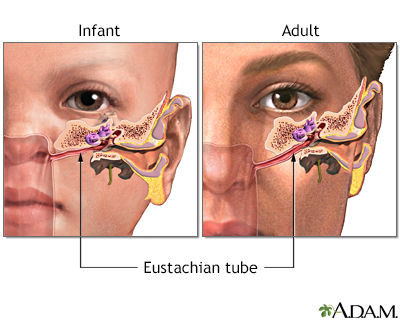
Now the real reason the fluid is trapped within the Middle ear is because the Eustachian tube, that connects the back of the nose with the Inner ear is blocked - usually by the swollen, inflamed membranes of the nasal passages. But most Doctors don't look up the nose of a child because it's already blocked with yellow/green mucous, and so patients often find it difficult to connect the idea that in order to fix the ear, you have to squirt something "up the nose"!
Dr Nsoulis study is another resource to help convince both patients and Doctors that in the case of middle ear problems, where there is a history of allergy, then inhaled nasal steroids are much the better option than repeated doses of antibiotics which, if truth be known, only lead to increased bacterial resistance of pathogens within the rest of the body: and that's not good medicine for anyone!
image
reference
Ampersands & angle brackets need to be encoded.Follow @DrDJsScript
One of the downsides to medicine having access to antibiotics, is that all too often we get to use them ... for the wrong reasons! There is also the trend, covered in a previous blog, for patients to ask for a "really strong" antibiotic, instead of asking for the correct antibiotic!
I was reminded of this when reading about a study from California and recently presented at the American College of Allergy, Asthma & Immunology 2011 Annual Scientific Meeting. In a relatively small study of children with a history of allergy, Dr. Nsouli and colleagues compared the effects of an 14 day course of antibiotics - amoxycillin and clauvulinic acid - with a 14 day course of an aqueous nasal spray containing the steroid Ceclosonide.
Their findings revealed that the Spray worked in 8 days, whereas the antibiotics took 14 days!
The problem with middle ear infections in children is a combination of size and obstruction: but it has nothing to do with the ear that we see on the side of the head - which Doctors call the outer ear. That the problem appears to lie within the external appendage is compounded by the fact that Doctors look into the Outer ear, in order to view the eardrum and thus confirm their suspicions of a Middle ear infection, which they do when we see a red ear drum bulging with fluid within the Middle ear.
Now the real reason the fluid is trapped within the Middle ear is because the Eustachian tube, that connects the back of the nose with the Inner ear is blocked - usually by the swollen, inflamed membranes of the nasal passages. But most Doctors don't look up the nose of a child because it's already blocked with yellow/green mucous, and so patients often find it difficult to connect the idea that in order to fix the ear, you have to squirt something "up the nose"!
Dr Nsoulis study is another resource to help convince both patients and Doctors that in the case of middle ear problems, where there is a history of allergy, then inhaled nasal steroids are much the better option than repeated doses of antibiotics which, if truth be known, only lead to increased bacterial resistance of pathogens within the rest of the body: and that's not good medicine for anyone!
image
reference
Wednesday, November 23, 2011
Another insight into Malignant Melanoma
Tweet
The first patient I ever saw as a medical student was a Dentist in the UK who had terminal, metastatic Melanoma: it wasn't a pretty sight and one that has stayed with me for nearly 40 years! Melanoma is still on the increase and is one of the more common amongst young people: there has been a staggering 50% increase amongst women under the age of 30 since 1980, so any advance in its research and treatment is to be welcome.
Apparently there is a gene called BRAF that is implicated in the spread of Malignant Melanoma, and one of the proteins associated with that gene - P-Rex1 (sounds like a pop group) - is found in higher levels in those with advanced disease. Now scientists have developed a drug that blocks this protein which so far has had beneficial results in experimental models, and has also shown significant survival benefits in human clinical trials.
This is not the end of the story by a long way, but may be the end of the beginning for our understanding where P-Rex1 protein fits into the overall picture, and how Melanoma spreads around the body. From this scientist will be able to develop more targeted treatments so that Melanoma can join all those other cancers that are now in decline, or being managed so much better.
image
reference
Ampersands & angle brackets need to be encoded.Follow @DrDJsScript
The first patient I ever saw as a medical student was a Dentist in the UK who had terminal, metastatic Melanoma: it wasn't a pretty sight and one that has stayed with me for nearly 40 years! Melanoma is still on the increase and is one of the more common amongst young people: there has been a staggering 50% increase amongst women under the age of 30 since 1980, so any advance in its research and treatment is to be welcome.
Apparently there is a gene called BRAF that is implicated in the spread of Malignant Melanoma, and one of the proteins associated with that gene - P-Rex1 (sounds like a pop group) - is found in higher levels in those with advanced disease. Now scientists have developed a drug that blocks this protein which so far has had beneficial results in experimental models, and has also shown significant survival benefits in human clinical trials.
This is not the end of the story by a long way, but may be the end of the beginning for our understanding where P-Rex1 protein fits into the overall picture, and how Melanoma spreads around the body. From this scientist will be able to develop more targeted treatments so that Melanoma can join all those other cancers that are now in decline, or being managed so much better.
image
reference
Tuesday, November 22, 2011
Soft drinks not so kool?
Tweet
Non diet soft drinks have been around for decades in the developed world, and what was once deemed a luxury is now casually bought and consumed, often without any awareness of the action. But dieticians and health workers have been concerned for some time about the current calorie binge in the "West" and in the developing world, and it's connection to the epidemic of worldwide obesity. One element of the excess intake of calories has been the universal availability of high sugar content, carbonated soft drinks, and many health education programs are focused on reducing the consumption of such drinks.
A report out of Boston has raised another possible negative link relating to carbonated soft drinks, and this time it's an increased rate of violence amongst teenagers in those who consume large amounts of such drinks. David Hemenway, MD, professor of public health and director of the Injury Control Center at the Harvard School of Public Health, Boston, Massachusetts, and his colleagues reviewed self reported data from 2725 teenagers (self reported data always makes me a bit dubious about any conclusions drawn from them) in the Boston Youth Study: and his findings are sure to stimulate debate for some time to come.
What they found was that teenagers who consumed more than five 12oz (350mls) of carbonated soft drink per week:
And of concern was the fact that nearly one in three reported that they consumed more than five cans of carbonated drinks per week. Interestingly, the authors did not report a link with obesity.
Soft drinks not only contain carbon dioxide dissolved in water, but they also contain
high fructose corn syrup, aspartame, sodium benzoate, phosphoric or citric acid, and often caffeine, so should the link be confirmed the next question would be "Which one(s) is(are) the culprit(s)"? But we shouldn't jump to the conclusion that soft drinks must be the "root of all evil" and legislate to ban them on the findings of this self reported research. But perhaps we should try to view carbonated soft drinks as something quirky to be tried on occasion, and not the first thing to quench a thirst when walking through the Mall: in many respects, iced-water is a much better choice.
reference
image
Ampersands & angle brackets need to be encoded.Follow @DrDJsScript
Non diet soft drinks have been around for decades in the developed world, and what was once deemed a luxury is now casually bought and consumed, often without any awareness of the action. But dieticians and health workers have been concerned for some time about the current calorie binge in the "West" and in the developing world, and it's connection to the epidemic of worldwide obesity. One element of the excess intake of calories has been the universal availability of high sugar content, carbonated soft drinks, and many health education programs are focused on reducing the consumption of such drinks.
A report out of Boston has raised another possible negative link relating to carbonated soft drinks, and this time it's an increased rate of violence amongst teenagers in those who consume large amounts of such drinks. David Hemenway, MD, professor of public health and director of the Injury Control Center at the Harvard School of Public Health, Boston, Massachusetts, and his colleagues reviewed self reported data from 2725 teenagers (self reported data always makes me a bit dubious about any conclusions drawn from them) in the Boston Youth Study: and his findings are sure to stimulate debate for some time to come.
What they found was that teenagers who consumed more than five 12oz (350mls) of carbonated soft drink per week:
- Were more likely to carry a weapon, and
- Were more likely to be violent towards siblings, dates and friends.
- Were getting insufficient sleep and
- Were using alcohol and tobacco within the past 30 days.
And of concern was the fact that nearly one in three reported that they consumed more than five cans of carbonated drinks per week. Interestingly, the authors did not report a link with obesity.
Soft drinks not only contain carbon dioxide dissolved in water, but they also contain
high fructose corn syrup, aspartame, sodium benzoate, phosphoric or citric acid, and often caffeine, so should the link be confirmed the next question would be "Which one(s) is(are) the culprit(s)"? But we shouldn't jump to the conclusion that soft drinks must be the "root of all evil" and legislate to ban them on the findings of this self reported research. But perhaps we should try to view carbonated soft drinks as something quirky to be tried on occasion, and not the first thing to quench a thirst when walking through the Mall: in many respects, iced-water is a much better choice.
reference
image
Subscribe to:
Posts (Atom)